
Tidal Power for Arnside: what are the possibilities?
Sustainable Arnside were delighted to welcome Dr David Howard, Professor George Aggidis and Mr Simon Baker to give a presentation on the possibilities for tidal power as a source of renewable green energy on 18th July 2024 at the Educational Institute in Arnside. David is from the UK Centre for Ecology and Hydrology, George and Simon from the School of Engineering at Lancaster University.
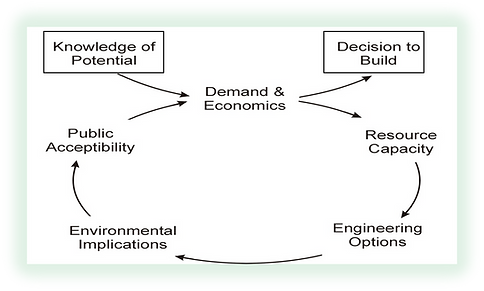
David started off with setting the scene and then handed over to George who took us through some local projects he has already been involved with, such as the hydro power station at the Heron Corn Mill (see figure below), and a surprisingly large number of ways that power can be extracted from the flow of tides. These include horizontal axis turbines, vertical axis turbines, ducted turbines, reciprocating devices, Archimedes screws and open centre turbines. There was even something called a tidal kite, which as the name suggests is like flying a kite but underwater. George pointed out that globally the UK has one of the best tidal range energy resources available, so clearly something we should be doing more about on a national scale. In the UK the northwest coast including Morecambe Bay has a significant tidal energy resource, second only to the Bristol channel. George also highlighted his concept that implementation of any idea is a multistage process (see diagram below), in which entering the process with “knowledge of potential” may require several cycles around the loop before exiting with a “decision to build”. However, if any of the steps around the cycle was insurmountable, for example “public acceptability” then the scheme would fail, so there would always be multiple challenges to overcome.

Simon then took us through some of the options he has investigated specifically for Arnside. He was at pains to point out that none of these were fully researched yet, and he was not advocating anything, but still a useful exercise as they give us an idea of what might be possible. Traditional hydroelectric power is not an option as we either have the height (Arnside Knott) but no mass (no water courses) or the mass (River Kent) but no height (little elevation rise). A tidal range lagoon was the next idea, essentially an enclosure built somewhere in the estuary that gets filled by the incoming tide, and then flows out through turbines when the tide goes out. According to his modelling this was better than hydroelectric in terms of energy generation but would be very expensive to build and maintain relative to the energy generated, so fell down on cost effectiveness grounds. Hydrokinetic options involve placing some type of turbine in the tidal stream. Given the ebb and flow of the tides and the river itself a vertical axis turbine seemed the best option there. The obvious place to site these would be along the existing railway bridge, but whether this would be possible would require detailed work and real data, as well as permission from the owners of the bridge! Still, it seemed the most viable option to exploit the tides in Arnside. Lastly Simon gave us a different idea, which is pumped hydro storage. This is where cheap electricity, from the grid at night or possibly from solar/wind, is used to pump water uphill, then later released through turbines to generate electricity when it is needed. Remarkably even a modest storage tank of 25x25x3 metres sited halfway up Arnside Knott (hidden somewhere in the trees) could generate a significant amount of energy relative to the needs of a village like Arnside. That gave us food for thought.
Then David discussed some of the environmental issues around tidal power options, pointing out that they would need to cope with the projected sea level rise of at least 1 metre by the end of the century (and that engineers were recommended to plan for 3 metres). The main environmental damage that is caused tends to be in the deployment stage, when the construction is done, rather than by the infrastructure itself, so that requires careful management. Then there are the energy cost and carbon emissions of any scheme to consider.
Finally, there was a brief mention of the “elephant in the room”. Our meeting was about ideas for Arnside, but of course there has been discussion on and off for years about a barrage across Morecambe Bay, which has enormous potential for green energy generation and economic benefit. In the past this has been opposed by many on ecological grounds, but the argument has become more nuanced with the destructive impact that rising sea levels will have on fragile environments such as our salt marshes and intertidal zones becoming more apparent. A barrage could potentially mitigate against such destructive impacts, but that was a discussion for another day.
To see the slides and for more information see the pdfs below:
Overview of the presentation
Generating electricity from water - a description of the technologies and options available
Tidal power for Arnside - the possibilities
Tidal range - environmental consequences of rising sea level